Spiritual Companionship for Secular People (and for anyone whose spiritual life doesn’t fit neatly within a traditional religious framework.)
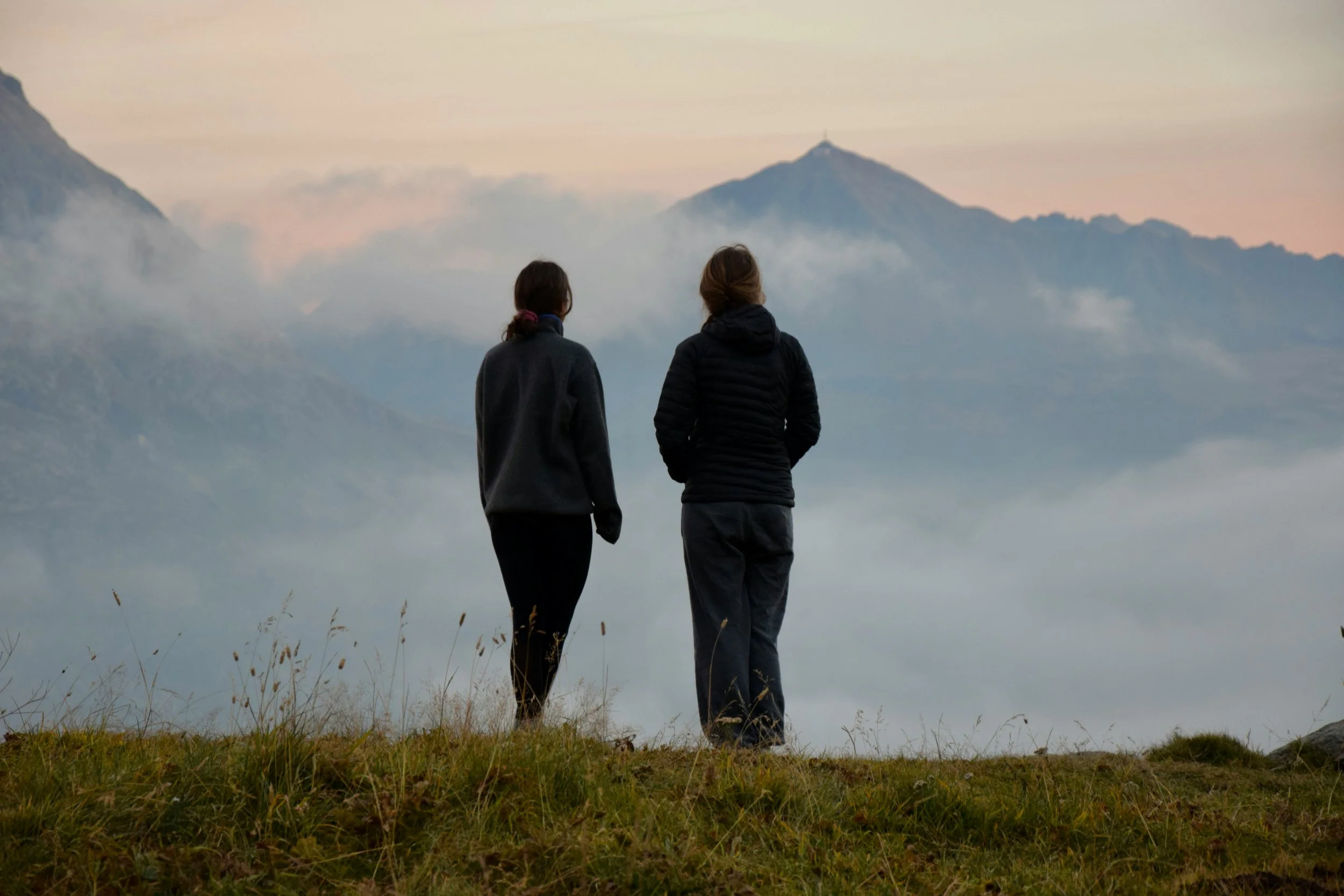
Spiritual Companionship for Secular People
Maybe it goes without saying, but you do not need to be religious to have a rich and textured inner life.
You do not need to believe in a deity, subscribe to a doctrine, or identify with a spiritual tradition to wrestle with existential questions of meaning, mortality, purpose, belonging, and how to live.
Many secular people have left behind religious institutions and belief systems for good reason. But leaving religion does not erase the human need for reflection, reverence, connection, or a relationship with something larger than the isolated self. Nor does it erase the questions that arise when a life changes shape, when an old identity no longer fits, when certainty disappears, or when we find ourselves standing at a crossroads.
These are not exclusively religious questions. They are human questions.
So what do I mean by spiritual?
I use the word spiritual carefully. I am not using it to imply supernatural belief, divine authority, or a hierarchy in which some people are more spiritually evolved than others.
For me, the spiritual dimension of life is the dimension concerned with meaning, mystery, the ineffable, the transcendent, paradox, mysticism, reciprocity, and our place within the web of life. It includes the questions that defy easy answers and the experiences that remind us that we are part of something larger than our individual concerns.
That larger whole may be understood as nature, the cosmos, community, ancestors and descendants, consciousness, and animacy. It may be encountered through love, grief, beauty, shock, tragedy, uncertainty, dreams, creativity, wonder, or the experience of standing beneath a night sky and remembering that we are living on a small planet within an incomprehensibly vast universe.
The infinite does not have to mean a supernatural being. It can name whatever stretches us beyond the confines of the personal and places our lives within a larger web of existence.
As Madeleine L’Engle wrote:
“There is nothing so secular that it cannot be sacred.”
The sacred, as I understand it, is not a separate category of life reserved for churches, temples, or people with particular beliefs. It can emerge through the quality of attention we bring to ordinary life. It becomes perceptible when we slow down enough to recognize that a moment or experience asks more of us than efficiency and forward motion.
The existential terrain we all share
We all move through periods of momentum and periods of fallowness. There are seasons when life feels generative and full of possibility, and others when nothing seems to be moving—when the work remains underground and we cannot yet see what, if anything, is taking root.
We encounter uncertainty, disorientation, loss, and questions that cannot be resolved with a quick solution. We experience endings that do not immediately produce new beginnings. We outgrow identities, relationships, ambitions, and ways of understanding ourselves before we know what will replace them.
At times, we lose faith. Not necessarily faith in a deity, but faith in ourselves, in life, in other people, or in the possibility that our hopes and dreams will ever come to fruition. We may need to reconsider what we believe, what we belong to, who we are becoming, or what our lives are asking of us now.
There is nothing pathological about encountering this terrain. It is part of being human. But that does not mean we are meant to navigate it alone or only through the lens of psychology.
What is spiritual companionship?
Spiritual companionship offers a place to bring these questions and experiences without being handed a prefabricated answer or told what to believe.
My approach is intuitive, grounded, compassionate, and non-hierarchical. Spiritual companionship is not about me positioning myself as someone who has the answers or telling another person what to do. It is about walking alongside someone with humility and an understanding that none of us stands above the existential terrain of being human.
The word companionship matters. A companion does not stand at the destination calling out directions. A companion walks beside you, helping you pay attention to the path, ask the nuanced questions, and notice the patterns that may be difficult to see from inside your own experience.
Through deep listening, reflection, and inquiry, I help people attend to what their lives may be asking of them. The purpose is not to impose meaning, but to create the conditions in which meaning can be discerned. It is not to rush uncertainty toward resolution, but to become more capable of inhabiting the unknown, and to feel more comfortable doing it.
What informs my approach
My orientation draws from ritual theory, astrology and astronomy, poetry, botany, biology, biomimicry, dreams and symbols, and an understanding of thresholds.
The natural world offers more than metaphor. It gives us observable models of dormancy, adaptation, interdependence, decay, regeneration, emergence, and right timing. A fallow field is not a failed field. A seed beneath the soil is not doing nothing. Ecosystems survive through relationship, responsiveness, diversity, and exchange. These patterns can help us reconsider the rigid and often punishing stories our culture tells about productivity, progress, and worth.
Poetry gives language to experiences that ordinary explanatory language cannot always reach. Dreams can bring forward images, tensions, and possibilities that conscious thought has not yet fully registered. Paying attention to them does not require treating every dream as prophecy or every symbol as a supernatural message. It means respecting that the psyche often communicates through image, association, contradiction, and metaphor.
The heavens offer perspective. The stars and constellations remind us of the vastness within which our brief human lives unfold. They can recalibrate wonder and loosen the grip of the immediate without diminishing the importance of our earthly lives.

Threshold literacy helps us recognize when we are moving between different territories of life. A threshold is more than an external crossing. It is a passage between identities, roles, relationships, or ways of being. Learning to recognize threshold territory means understanding its opportunities and its pitfalls: what may need to be grieved, released, honored, integrated, blessed, or consciously carried forward. As John O’Donohue wrote, “A threshold is not a simple boundary; it is a frontier that divides two different territories, rhythms and atmospheres… To acknowledge and cross a new threshold is always a challenge. It demands courage and also a sense of trust in whatever is emerging.”
None of these perspectives is grounded in doctrine. They are simply ways of paying attention. They are different lenses through which we can perceive pattern, relationship, meaning, and possibility in our lives.
Who is this for?
Spiritual companionship may be useful when you are:
Moving through a transition, threshold, initiation, crossroads, midlife passage, dark night of the soul
Experiencing a period of fallowness, uncertainty, rearrangement, or lost direction
Standing between an ending and a beginning, or navigating a change that has altered your sense of self
Beginning or deepening a spiritual journey and seeking grounded, discerning support
Deconstructing fundamentalist conditioning without wanting to discard everything of value
Watching a political, ideological, or philosophical framework that once felt certain begin to fracture
Carrying an intention or vision that you want to tend as it takes shape and reveals its own timing
Exploring dreams, symbols, recurring patterns, or what your life may be asking of you
Longing for a deeper relationship with nature, animacy, mystery and the more-than-human world
Working with questions that need accompaniment not immediate resolution
You do not need to arrive with a clearly defined spiritual or existential problem. You may simply sense that the usual ways of thinking are not reaching the depth of what you are experiencing.
Spiritual companionship is not psychotherapy, although there can be some overlap in the territory we explore. I want to be very clear that I am not a therapist, and I do not diagnose or treat mental-health conditions. This work is centered on meaning-making, discernment, deep reflection, and accompaniment.
Walking the questions together
Spiritual companionship begins with a simple premise: you retain complete sovereignty over your own life, beliefs, choices, and meaning-making.
I am not here to give you a cosmology, translate your life into a belief system, or claim special access to truth. I am here to listen carefully, ask meaningful questions, notice patterns, and help you remain in relationship with the deeper currents of your own life and experience.
My approach is grounded enough to remain rooted in the realities and responsibilities of ordinary life, intuitive enough to listen beyond the immediately obvious, and humble enough to honor the mystery of existence and the diversity of human experience and expression.
My ministerial training prepared me to support people through spiritual growth and life transitions through deep listening, reflection, ceremony and ethical discernment. I also have been blessed with wise elders who have walked with me through many seasons of my life, and I feel blessed to be able to offer that support to others. This work is tender, brave, rich, and collaborative, and I approach it with care, respect, attunement, and a healthy dose of realness and levity.
If you are curious about working together please reach out.